Little Bird that Sews
In this post, let's get to know about this cute tailor!
4/8/20251 min read
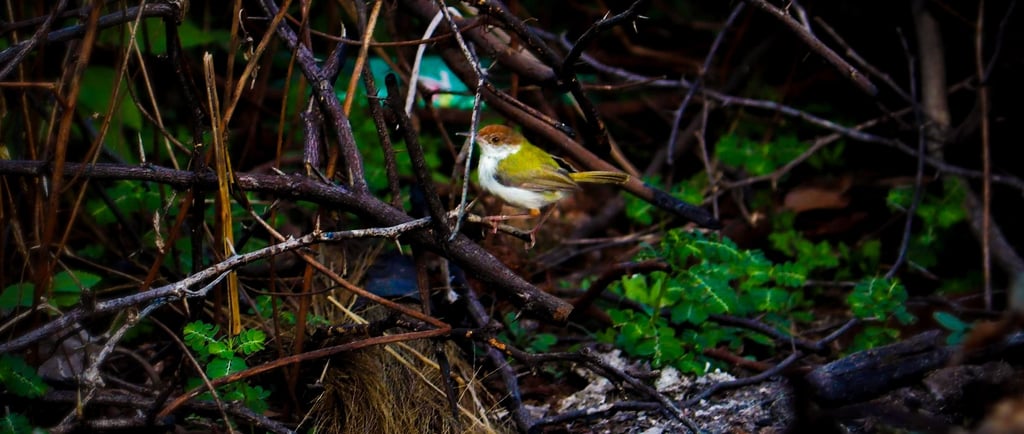
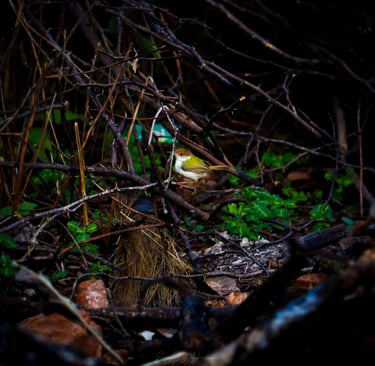
This little, energetic bird called Common Tailorbird gets its name from its exquisite nesting behavior - it sews the leaves together with plant fibers, spider silks, etc to make a cradle-like nest.
Common Tailorbird – Profile
Scientific Name: Orthotomus sutorius
Family: Cisticolidae
Conservation Status: Least Concern (IUCN Red List)
Habitat
Found in South and Southeast Asia, including India, Sri Lanka, Bangladesh, Nepal, and parts of Thailand and Indonesia.
Prefers gardens, urban parks, scrublands, open woodlands, and areas near human settlements.
Adapts well to urban environments and is often seen hopping through shrubs and bushes.
Appearance
Small bird (approx. 13–14 cm long), with a long upright tail.
Olive-green upperparts, pale underparts, and a rufous (rust-colored) crown.
The tail is often cocked upward.
Males have longer tail feathers during the breeding season.
Food Habits
Insectivorous – feeds mainly on insects, spiders, and small invertebrates.
Actively forages in low bushes and undergrowth, flitting about quickly.
Also occasionally consumes nectar or small fruits.
Nesting Behavior
Famous for its "tailoring" skills – it pierces the edges of large leaves and "sews" them together using threads made of plant fiber, cobwebs, or silk from insect cocoons.
The sewn leaves form a pocket, inside which a soft cup-shaped nest is built.
The female lays 2–4 eggs, usually pale greenish or bluish in color.
Both parents take part in feeding the chicks.
Calls and Songs
Very vocal, especially during the breeding season.
Emits sharp, loud, and repetitive calls like "cheeup-cheeup" or "tew-tew-tew".
Their calls are often heard in gardens and hedges, even when the bird itself remains hidden.
Conservation Status
Listed as Least Concern by the IUCN due to its wide distribution and adaptability.
Not currently facing any major threats.
Its ability to thrive near humans has helped maintain its population.
Let's keep them quenched this summer. Every summer, keep water bowls wherever you can.
Shiney Balakrishnan
Contacts
nkshiney@gmail.com